AERO Predictive Control Benchmark
MATLAB benchmark putting linear MPC, iterative nonlinear MPC, subspace predictive control and Koopman-lifted SPC on the same pitch and yaw tracking problem under one evaluation workflow.
- Stack
- MATLABYALMIPMPT3Koopman OperatorSubspace Methods
Results
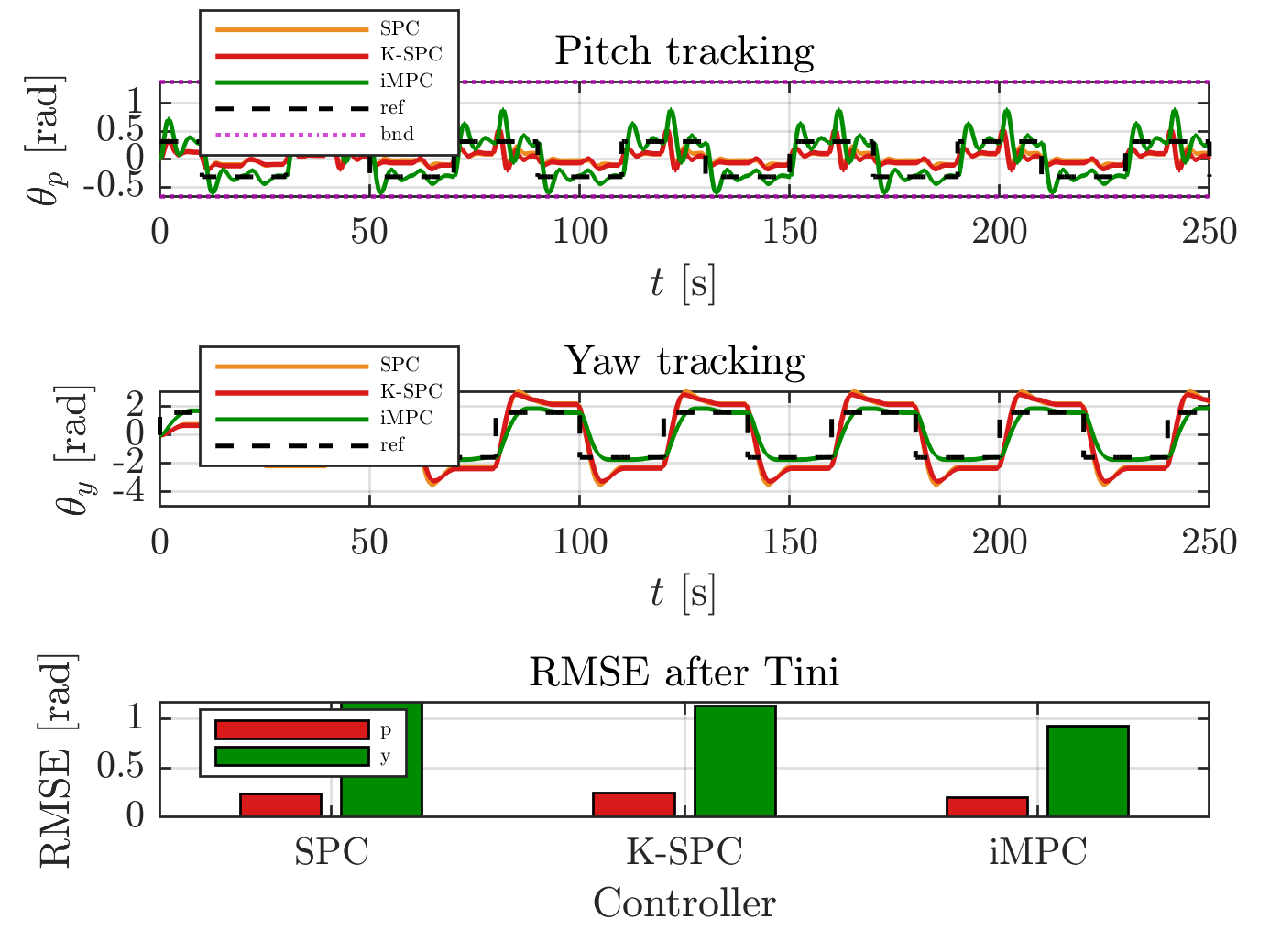
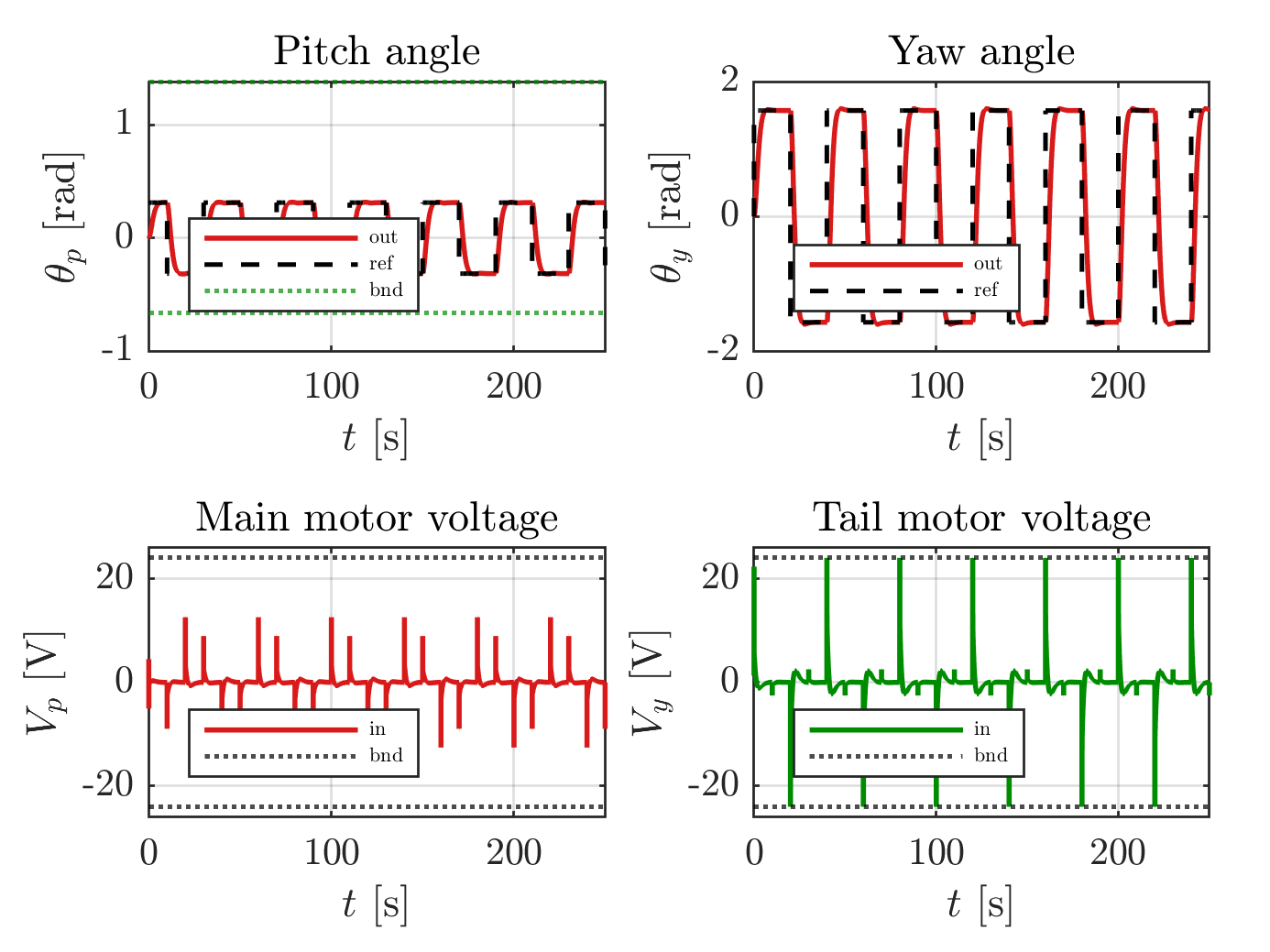
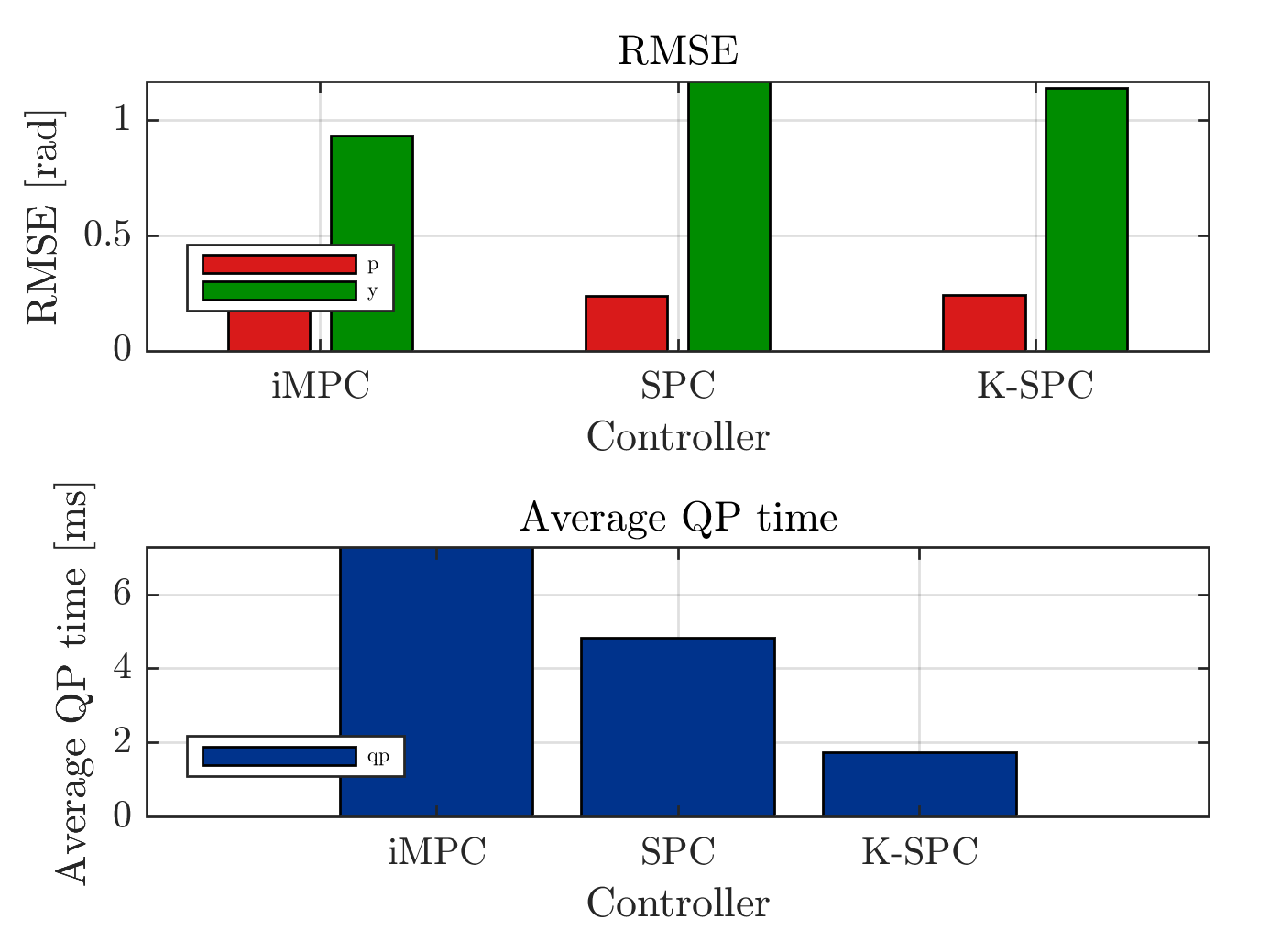
- Linear MPC tracked best overall, pitch RMSE 0.1756 and yaw RMSE 0.8767
- Improved iterative nonlinear MPC followed at 0.1955 and 0.9340
- Koopman-lifted SPC improved yaw over baseline SPC, 1.1385 against 1.1702
Problem
The AERO system couples pitch and yaw, so a controller cannot treat the two axes independently. The question the benchmark asks is narrow and useful: given the same plant, the same reference and the same evaluation, how do model-based and data-driven predictive controllers actually compare?
Approach
Five controllers were built and run through one workflow. Linear MPC with terminal set certification provides the model-based reference point. A baseline MPC and an improved iterative MPC handle the nonlinear plant. Subspace predictive control derives its predictor from Hankel matrices of input and output data rather than a model, and Koopman-lifted SPC extends that predictor with a lifted basis and ridge regularisation.
The solver stack is YALMIP with quadprog and MPT3.
What the benchmark actually showed
The data-driven controllers did not beat the model-based ones. Linear MPC recorded the best tracking of the five, and the improved iterative MPC came next. Koopman lifting bought a modest yaw improvement over the subspace baseline it extends, but did not close the gap to MPC.
That is a useful result rather than a disappointing one. When a good model is available and the terminal set can be certified, the model is hard to beat, and the case for a data-driven predictor rests on situations where that model is not available. Reporting it the other way round would misrepresent the comparison.
Data
The original .mat datasets and model matrices are course-provided and are not
redistributed. The code is published for review; a full run needs those local
files.