Embedding Lab
A 64-dimension embedding model trained from scratch in NumPy on NumPy and SciPy docstrings, compared with TF-IDF, BM25, LSA and static-vector baselines on the same text and queries; the trained model loses to BM25.
- Stack
- PythonNumPySciPyContrastive LearningBM25Retrieval Evaluation
Results
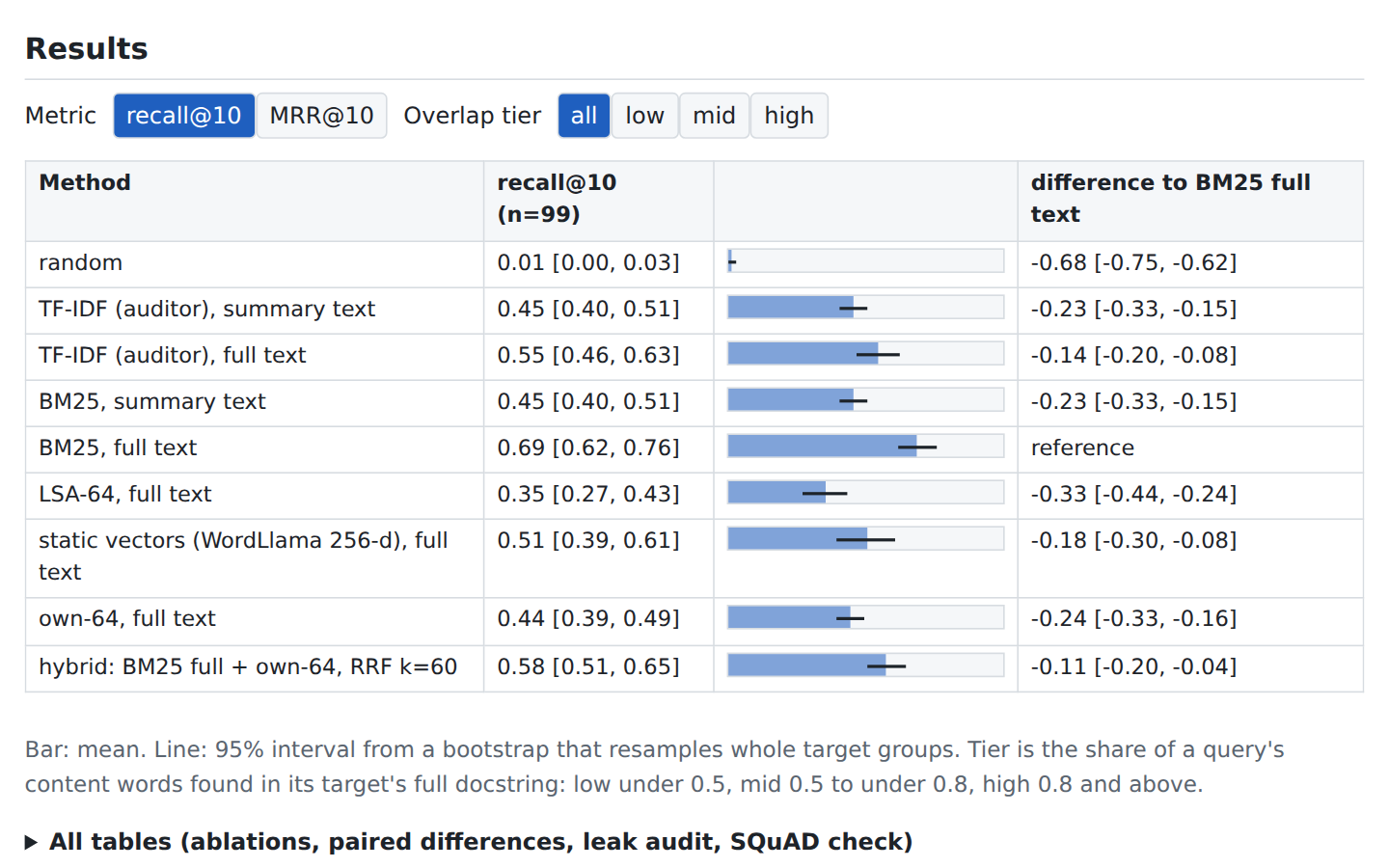
- On 99 fixed queries, BM25 on full text scored recall@10 0.69 against 0.44 for the 64-dimension model
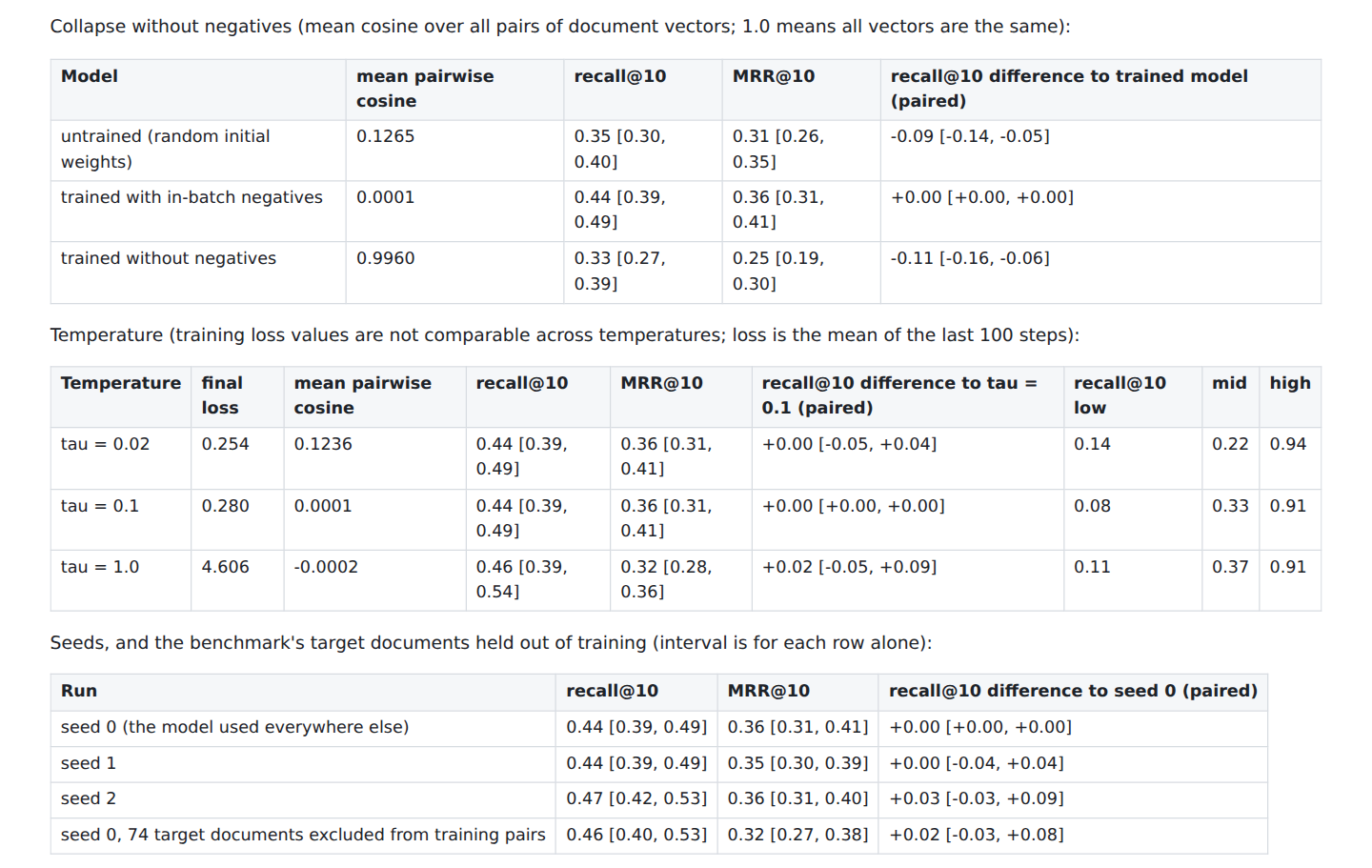
- Trained without negatives, the vectors collapsed, with a mean pairwise cosine of 0.9960 against 0.0001 with them
- Training improved recall@10 over the untrained random projection by 0.09
Problem
An embedding model is usually consumed as a service that someone else trained. This project shows how one is produced and compares it with the lexical retrieval used in the Enterprise AI Document Risk Auditor, on text that can be inspected line by line.
Approach
The model is a two-tower encoder with 64 dimensions. Each word has a learned vector and a text is the length-normalized mean of its word vectors. It trains on pairs of a docstring’s summary line and the rest of that docstring, with a symmetric contrastive loss and in-batch negatives.
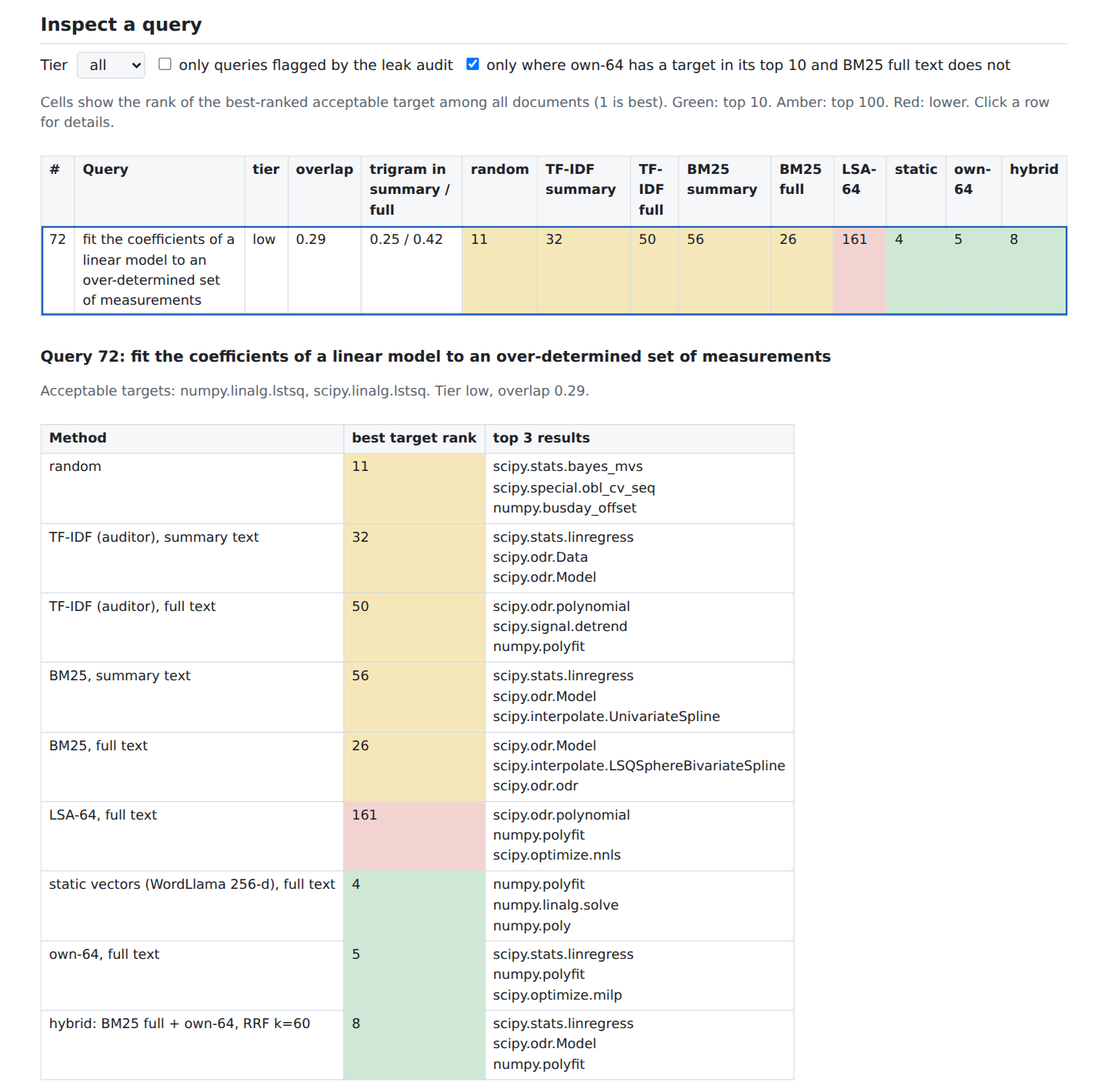
The gradient is derived analytically, implemented in NumPy without an autodiff library and checked against finite differences. It is optimized with Adam. A static page in the repository shows the results and lets a reader open any query to see how each method ranked it.
Evaluation
The benchmark has 99 fixed queries in 33 target groups, tiered by word overlap computed in code, with a trigram leak audit and paired cluster-bootstrap intervals. SQuAD dev is a second, human-written query set. BM25 on full text beat the model: recall@10 0.69 against 0.44 (0.67 against 0.41 without the 6 queries that copy a target’s summary line).
Removing the negatives collapsed the vectors (mean pairwise cosine 0.996 against 0.0001), and training improved on the untrained random projection by 0.09 recall@10.
Limitations
The encoder is a bag of word vectors, not a transformer, and it trains on the documents it searches. The leak audit flagged 32 of the 99 queries (28 of them in the high-overlap tier) and none were removed. The corpus has 1,714 documents. The queries and the acceptable targets come from one author, and no second person checked them; 6 of the 99 queries repeat a target’s summary line. A run against a real embedding model, and the Azure AI Search mapping, are not validated.