Enterprise AI Document Risk Auditor
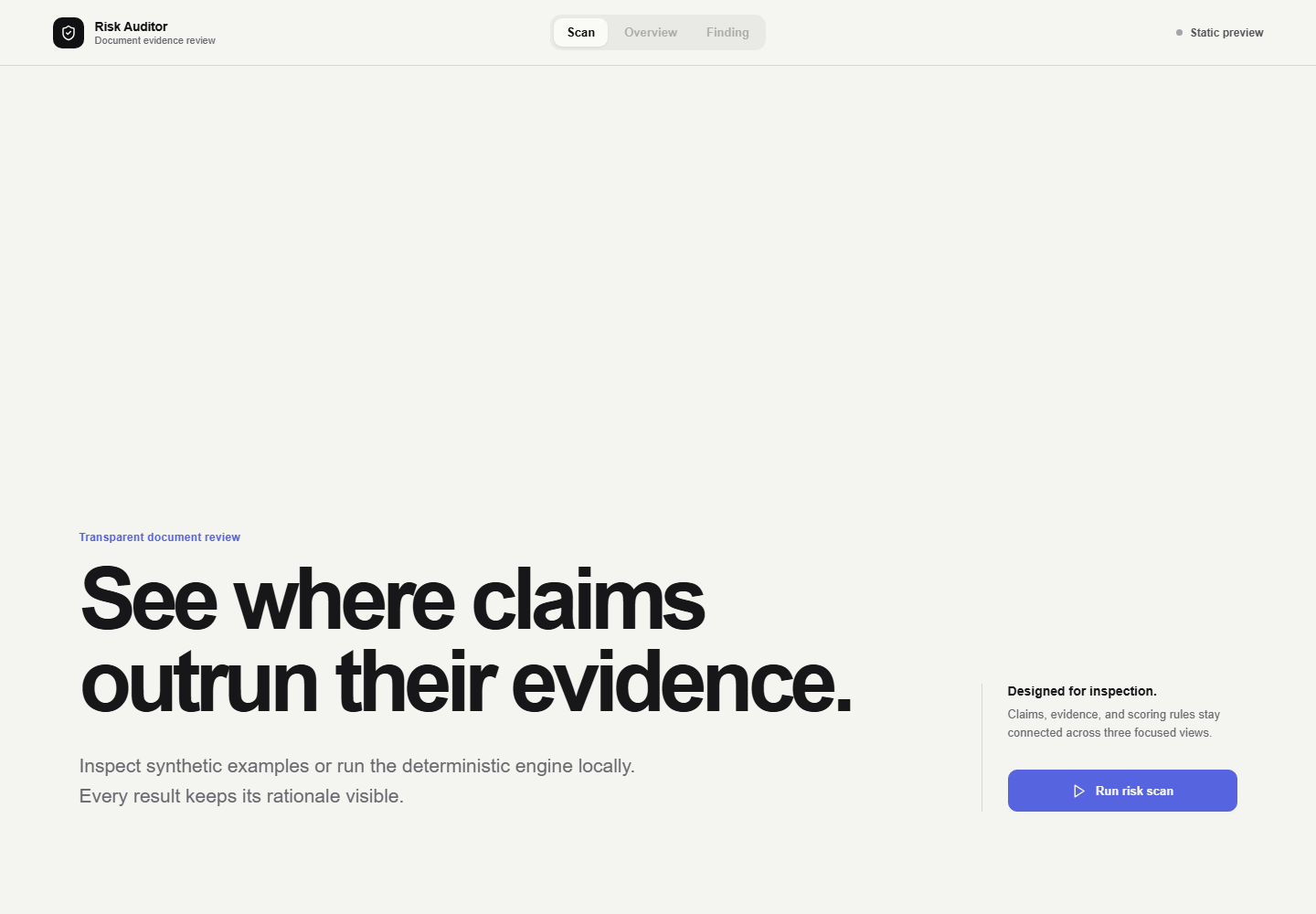
Local FastAPI and React tool that extracts factual claims from a business document, retrieves supporting passages, and scores how well each claim is grounded in evidence before a human signs it off.
- Stack
- PythonFastAPIReactTF-IDF RetrievalLocal LLMAzureTerraformDocker
Problem
Enterprise AI systems increasingly draft the policies, reports and recommendations that people then act on. Fluency is not the risk. The risk is whether the load-bearing claims in a document are actually supported by evidence, scoped correctly, and safe for a reviewer to approve.
Reading a generated report end to end and checking every assertion manually does not scale, and the reviewer has no systematic way to see which claims deserve their attention first.
Approach
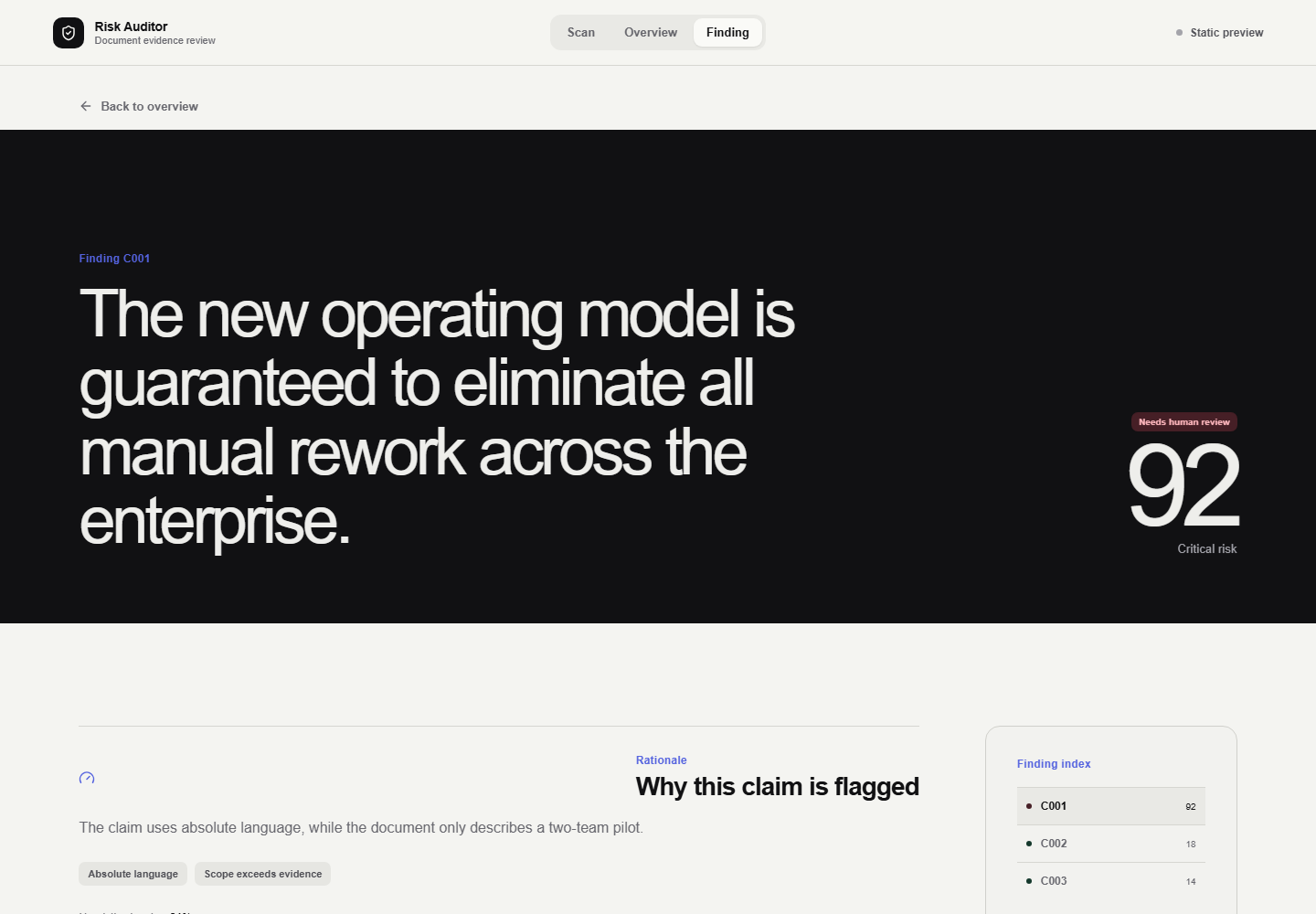
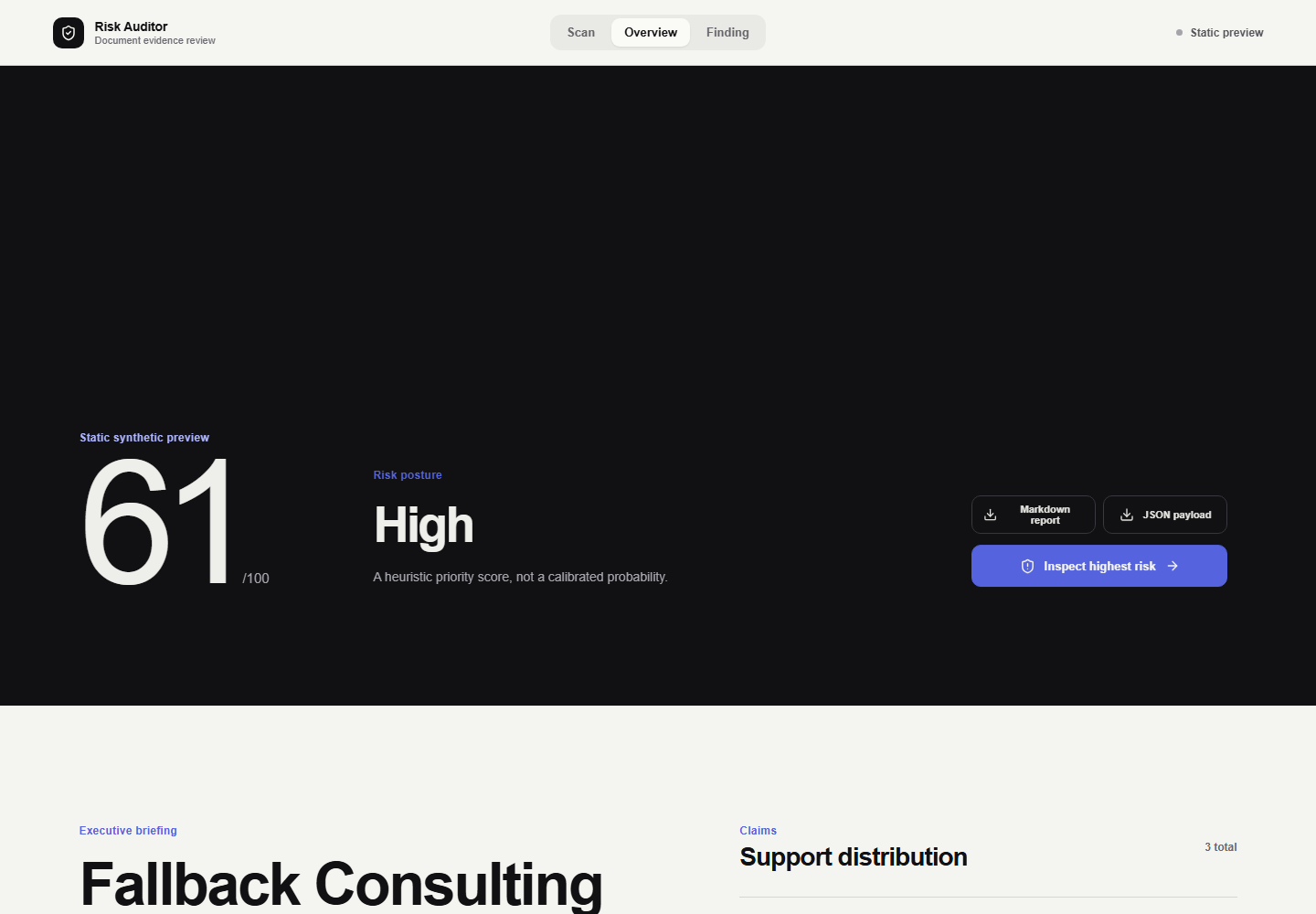
The tool ingests a document, chunks it, extracts the sentences that read as factual claims, and retrieves supporting passages using TF-IDF over the document itself or an optional evidence pack. Each claim is then labelled as supported, weakly supported, unsupported, vague or non-verifiable, or needing human review, and carries a transparent risk score, the evidence snippets behind it, and a review checklist. Audits export as Markdown or JSON.
The design decision that matters is the split between the two layers. The deterministic pipeline is the auditable baseline: ingestion, chunking, claim extraction, retrieval, scoring, labelling and export are all reproducible and require no language model at all. A local Gemma reviewer, served through LM Studio, is an optional interpretive layer on top; it annotates the highest-risk claims with notes, safer rewrites and missing-evidence questions.
The reviewer never decides the score, the label, or the retrieved evidence, and the audit completes whether or not it is running. That ordering is deliberate: a governance tool whose output changes depending on whether a model was available would not be auditable.
Deployment
The tool was deployed on Azure, with every resource defined in Terraform and nothing manually assembled in the Portal. The React frontend was served from Static Web Apps, the FastAPI backend ran on Container Apps behind a system-assigned managed identity, sample documents were uploaded to Blob Storage, and Terraform state was held remotely so the stack was not tied to one laptop.
The public deployment was intentionally retired in September 2026 after the infrastructure and recovery path had been demonstrated. The project now remains a local, synthetic-data portfolio demo rather than an unneeded standing cloud service.
The constraint that shaped the deployment was cost: it had to sit idle within free-tier capacity. The backend therefore used zero minimum replicas, the container image was pulled from a public GitHub Container Registry package rather than a paid Azure registry, and log ingestion was capped. This was a cost-control design, not a claim that cloud spend could never occur.
That choice had a visible cost, and the deployed site stated it rather than hiding it: the first request after an idle period took about twenty seconds while a container cold-started, against roughly 300ms once warm. Keeping a container resident would have removed the wait and replaced it with a permanent monthly bill, the wrong trade for a project whose point was that it could sit idle indefinitely. The frontend explained this on the first slow request instead of showing a bare spinner, because an unexplained twenty-second wait reads as a broken app.
No application secrets existed in the deployment. The container registry was public, so there were no registry credentials to hold. Shared keys were disabled on the storage account that held the samples, so no key or SAS token existed to leak there. Key-based access was refused by the platform, including for Terraform itself, which authenticated with Entra ID. Two things sat outside that statement. The Static Web Apps deployment token was a sensitive Terraform output that the application never read; it was printed once and rotated, so its handling depended on discipline. And the separate Terraform-state storage account still had shared keys enabled, although Terraform and the operator reached it with Entra ID.
The backend identity held exactly one role, scoped to the single blob container of samples rather than to the storage account. That grant was provisioned and checked by listing it, but the app served its samples from the container image, so nothing read a blob with that identity.
The stack was destroyed and rebuilt from scratch to prove it was reproducible rather than merely deployable once. That exercise surfaced something worth knowing: Azure assigned new hostnames on recreate, and since the API URL was compiled into the frontend bundle at build time, a rebuild and redeploy was part of the recovery, not an afterthought.
Evaluation
The included examples are synthetic and demonstrate the workflow rather than establishing model quality. CUAD can be used locally as a long-document contract stress test, but it is not presented as a hallucination-detection benchmark.
A separate retrieval benchmark in evals/retrieval compares the tool’s shipped
TF-IDF scorer with sublinear TF-IDF, BM25, LSA, static dense vectors and
reciprocal rank fusion. It runs on SQuAD dev-v1.1 (10,570 questions over 2,067
paragraphs) and on CUAD-QA (6,500 queries over 501 contracts, split into
sentences by the tool’s own chunker), and reports nDCG@10 with bootstrap
intervals over whole paragraphs or contracts. On SQuAD, BM25 scores 0.846
against 0.750 for the shipped scorer, and sublinear TF-IDF scores 0.825, which
recovers about three quarters of that gain, so most of it comes from how term
frequency is weighted. On CUAD sentences the shipped scorer, sublinear TF-IDF
and two BM25 settings lie between 0.316 and 0.332. Static dense vectors score
below the shipped scorer on both sets. Fusing the dense vectors with BM25 lowers
nDCG@10 on SQuAD by 0.051 and raises it on CUAD by 0.009.
These sets test query-to-passage retrieval. They do not test claim-to-evidence retrieval, which is the tool’s task, and CUAD’s queries are 41 fixed category prompts. The dense row is a static embedding model, so it says nothing about transformer embeddings. Each run also scores the rankings against gold labels dealt to other queries, as a check that the scores depend on the labels. An earlier FEVER experiment was removed after review found that its preparation path leaked gold-label information into pipeline inputs; the code stays in the repository history.
Limitations
The scorer is transparent, not a truth engine. It can miss implicit support, evidence that only exists in a table, and domain-specific nuance, and PDF handling is only as good as the embedded text. Every document shipped with the project is synthetic, so nothing in the repository contains client or personal data.