Facial Expression Recognition with Classical ML
Computer-vision pipeline that detects a face, extracts HOG features and classifies it into seven expressions, built as a transparent classical baseline rather than a deep-learning system.
- Role
- University project, curated public version
- Stack
- PythonOpenCVscikit-learnHOGSVM
Results
- Accuracy 0.523 on the public test split
- Balanced accuracy 0.508, against a seven-class chance rate near 0.14
Problem
Classify a face image into seven expressions, angry, disgust, fear, happy, sad, surprise and neutral, at a cost light enough to run on laptop-camera frames in approximately real time.
Approach
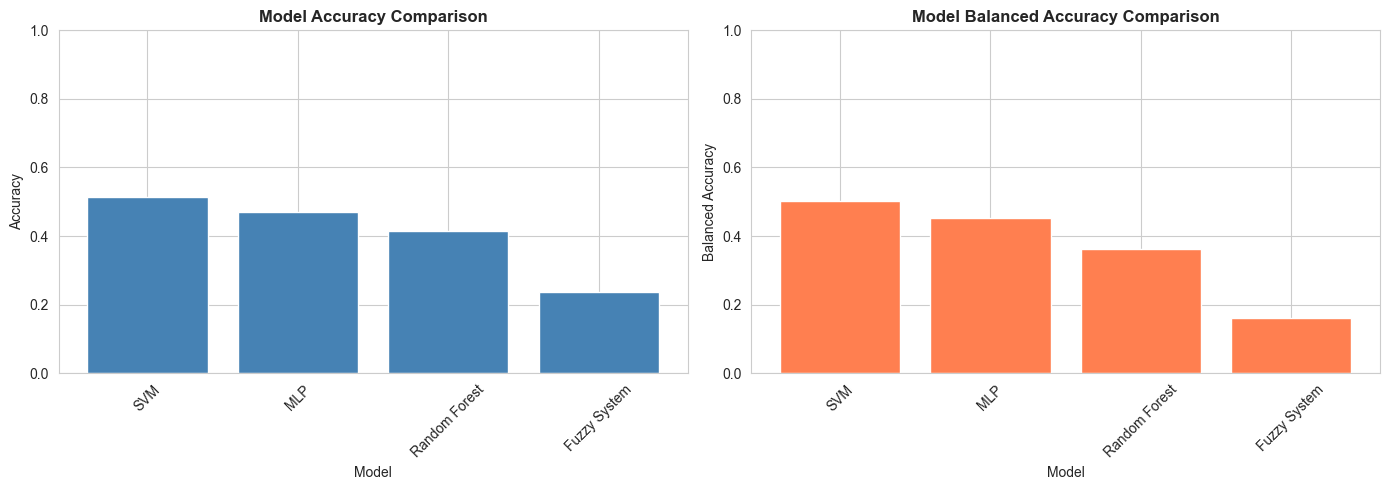
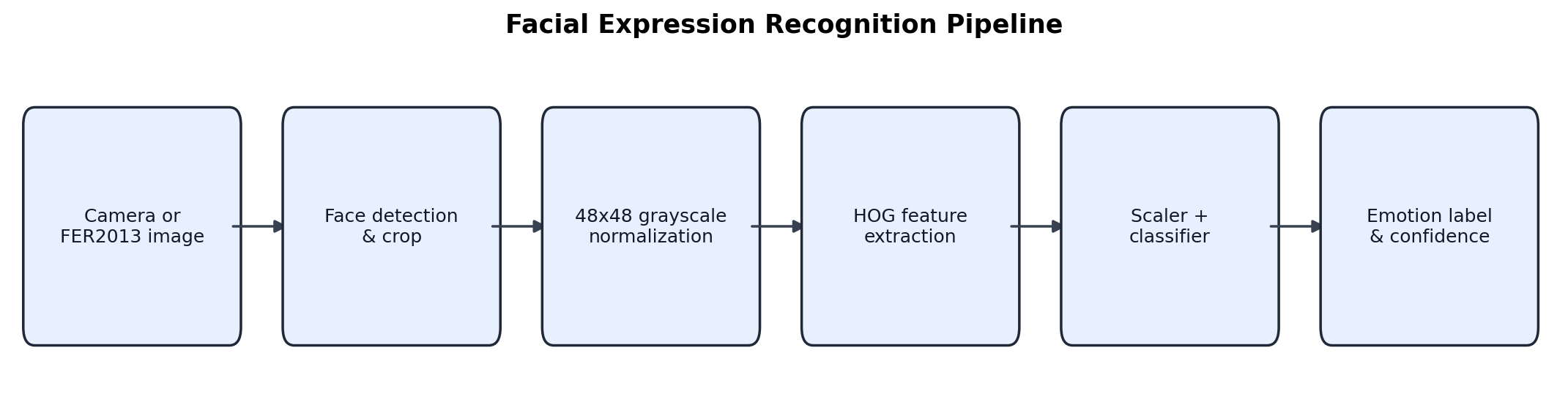
The pipeline detects a frontal face with an OpenCV Haar cascade, crops and converts it to a 48x48 grayscale image, extracts Histogram of Oriented Gradients features, and classifies the resulting fixed-length vector. Several classical models were trained and compared, including an SVM, an MLP, a random forest and a fuzzy-system variant, and evaluated with accuracy, balanced accuracy, classification reports and confusion matrices.
An SVM over HOG features was selected as the baseline.
What the numbers mean
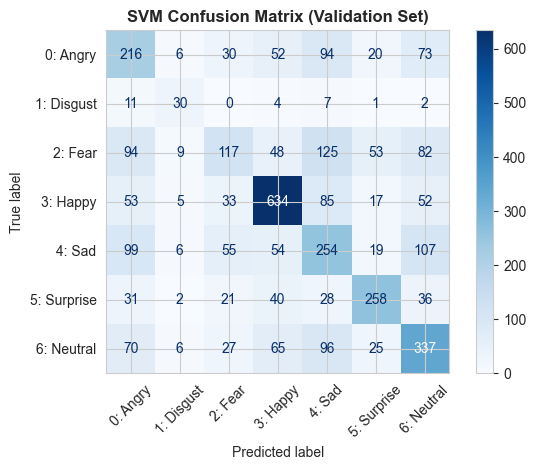
The seven-class problem has a chance rate near 0.14, so a balanced accuracy around 0.51 is a working classical baseline rather than a solved problem. The confusion matrices are the more informative artefact: the errors concentrate between expressions that are genuinely close in appearance.
This is a transparent baseline, not a production emotion-recognition system, and it should not be treated as one.
Data
The public version does not redistribute the restricted dataset. It keeps the code, the structure and the recorded evaluation outputs, and expects FER2013-style inputs.