Petri-Net Discovery with Genetic Algorithms
Evolves Petri-net structures from event-log traces with a genetic algorithm, comparing crossover, mutation and selection operators against a combinatorial search space.
- Stack
- PythonDEAPpm4pyNumPyEvolutionary Computation
Results
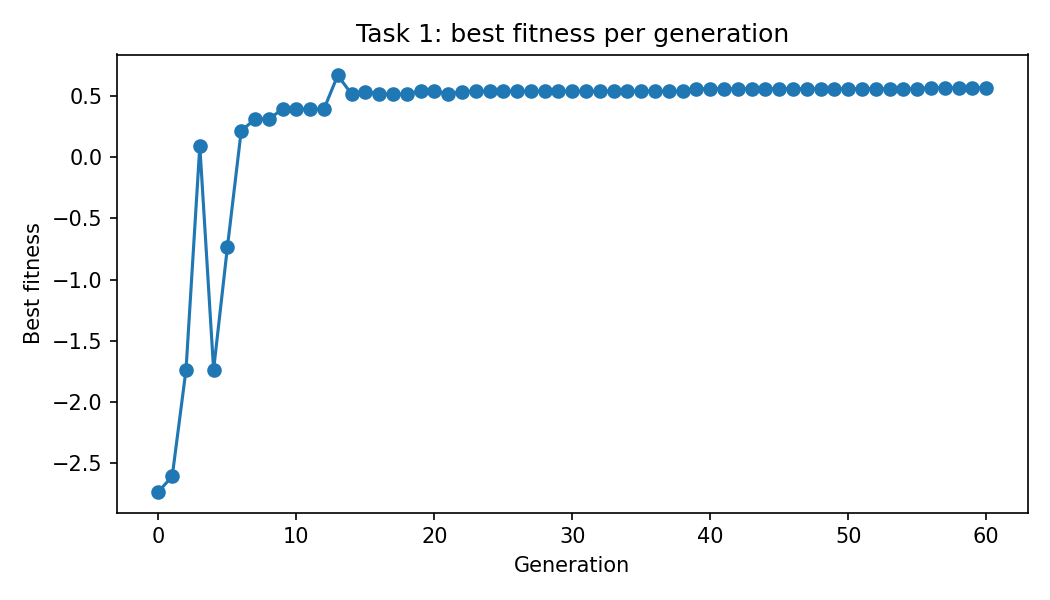
- Baseline and decorated best-found candidates both reached alignment fitness 1.0 in the selected Task 5 run
- Perfect replay conformance on that event log, with no structural penalties applied
Problem
Process mining can express a workflow as a Petri net, but the space of candidate net structures grows combinatorially with the number of activities, so it cannot be enumerated directly.
Approach
Candidate nets are encoded as integer chromosomes over the arcs, and evolved with a DEAP-based genetic algorithm whose fitness is evaluated against the behaviour recorded in the event log.
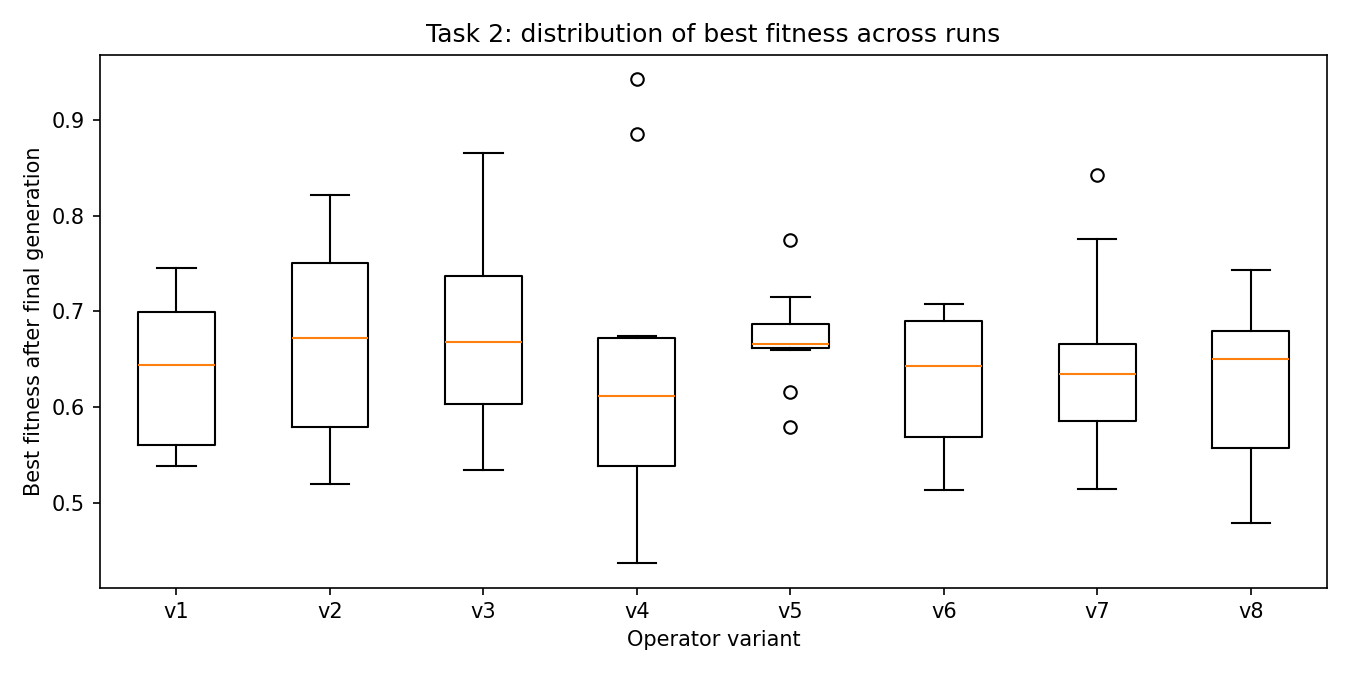
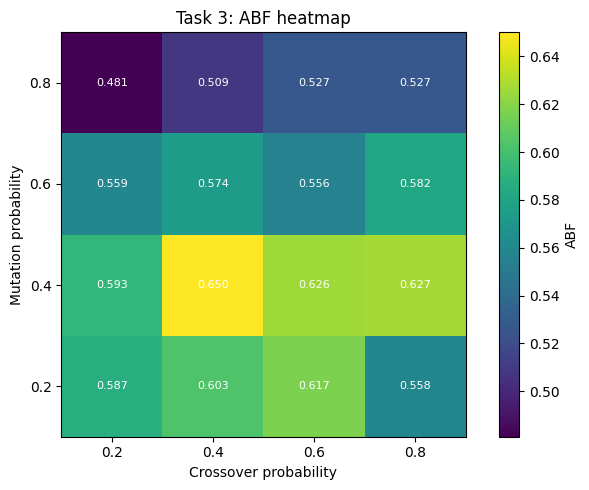
Beyond the baseline run, the project compares operator choices across crossover, mutation and tournament settings and sweeps the hyperparameters, so the output is a comparison of search strategies rather than a single tuned result.
What a fitness of 1.0 means here
Both the baseline and decorated best-found candidates reached alignment fitness 1.0 in the selected run. That is a specific claim and worth stating precisely: the discovered net replays the traces in that event log perfectly, and no structural penalty was applied against it.
It is not an average across repeated runs, and it is not a claim that the discovered model is correct in every other respect. Alignment fitness measures replay conformance against one log. A net can replay a log perfectly and still be more permissive than the real process, which is why the operator comparison and the hyperparameter sweep are the more informative parts of the project.
Data
The original full event log is not published. A small synthetic example ships with the repository to document the expected trace format, and reproducing the full benchmark requires the original log.