Smartphone Activity Recognition from IMU Signals
Classifies human activity from phone accelerometer and gyroscope signals, with participant-level validation that shows how far the model actually generalizes to people it has never seen.
- Stack
- PythonNumPypandasscikit-learnSignal Processing
Results
- Balanced accuracy 0.962 on a stratified holdout, random forest
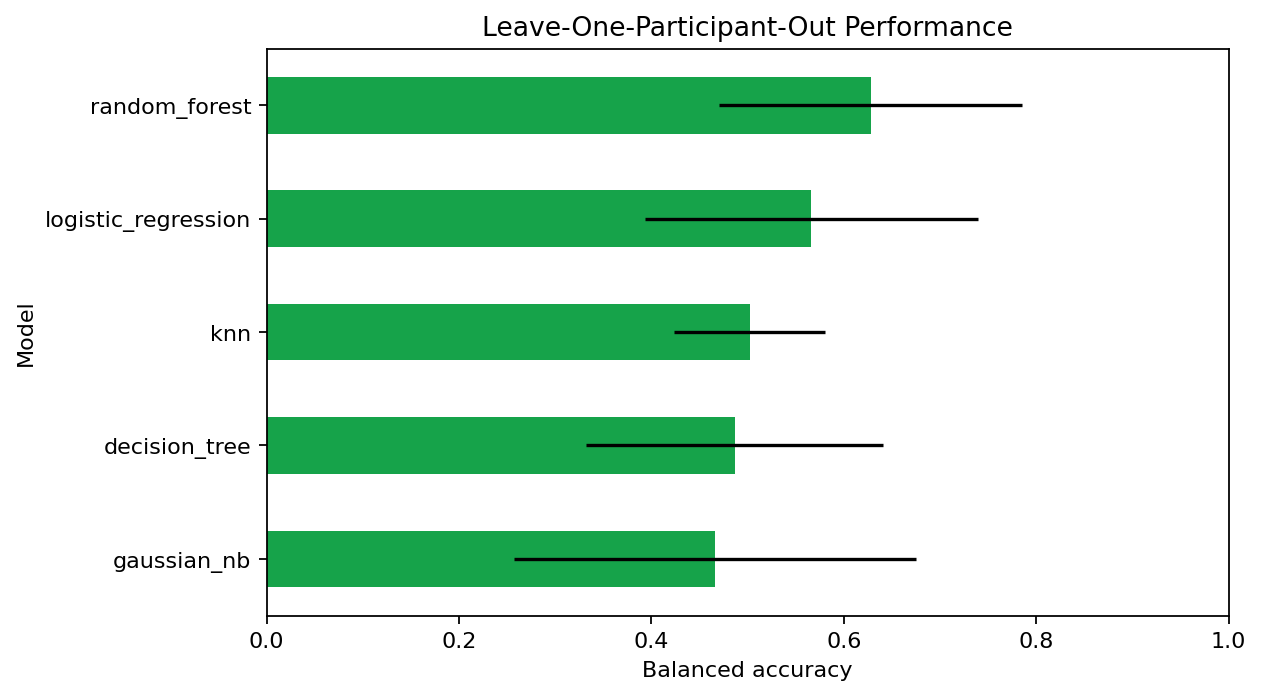
- Balanced accuracy 0.628 mean under leave-one-participant-out validation
Problem
Phone IMU signals can distinguish sitting, standing, walking, running and stair climbing. The harder question is whether a model trained on one set of people still works on someone new, since gait and phone placement vary between individuals.
Approach
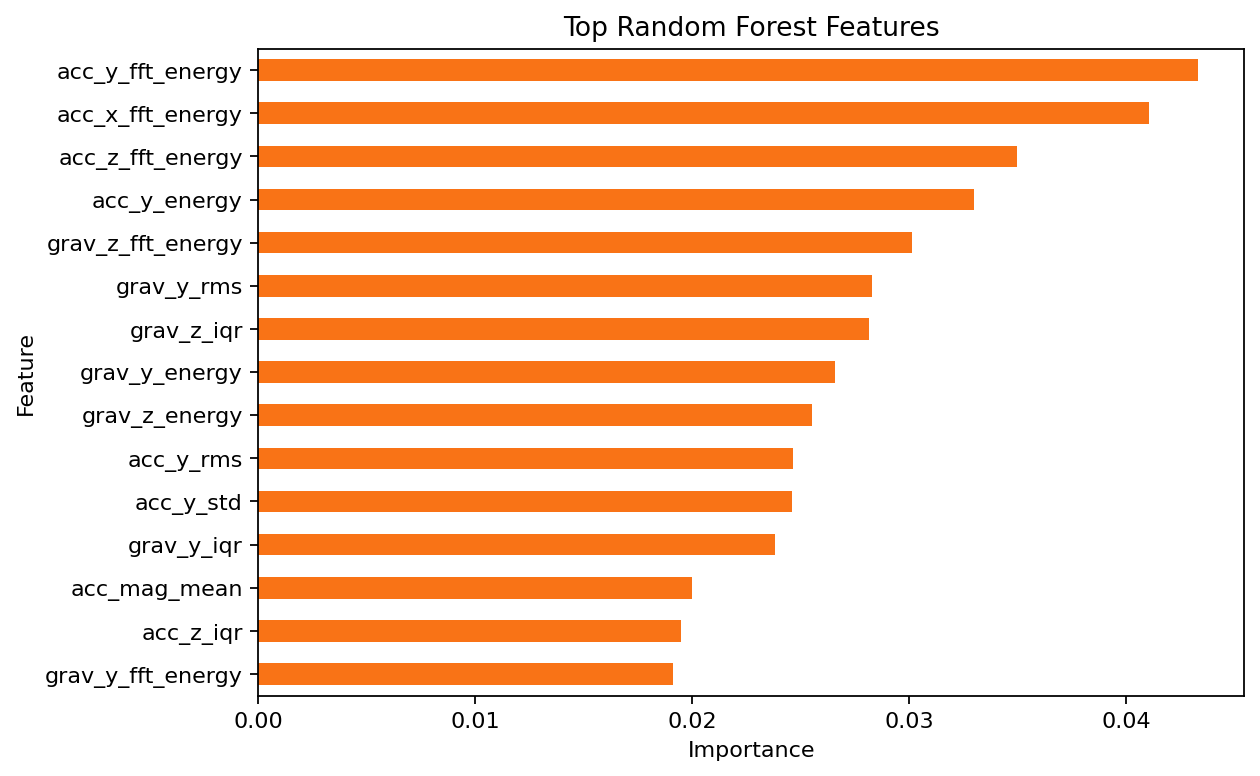
Accelerometer and gyroscope streams are cut into windows, then summarised with time-domain statistics and frequency-domain energy features. Feature selection uses mutual information and recursive feature elimination. Several classifiers were compared, including logistic regression, decision trees, naive Bayes and k-nearest neighbours.
The result that matters
The gap between the two validation schemes is the finding. A stratified holdout scores far higher than leave-one-participant-out validation, because a random split lets windows from the same person land in both training and test data. Holding out a whole participant removes that leakage, and the score drops sharply.
The lower number is the honest estimate of how the model behaves on a new user. Reporting only the holdout figure would overstate the system by a wide margin.
Data
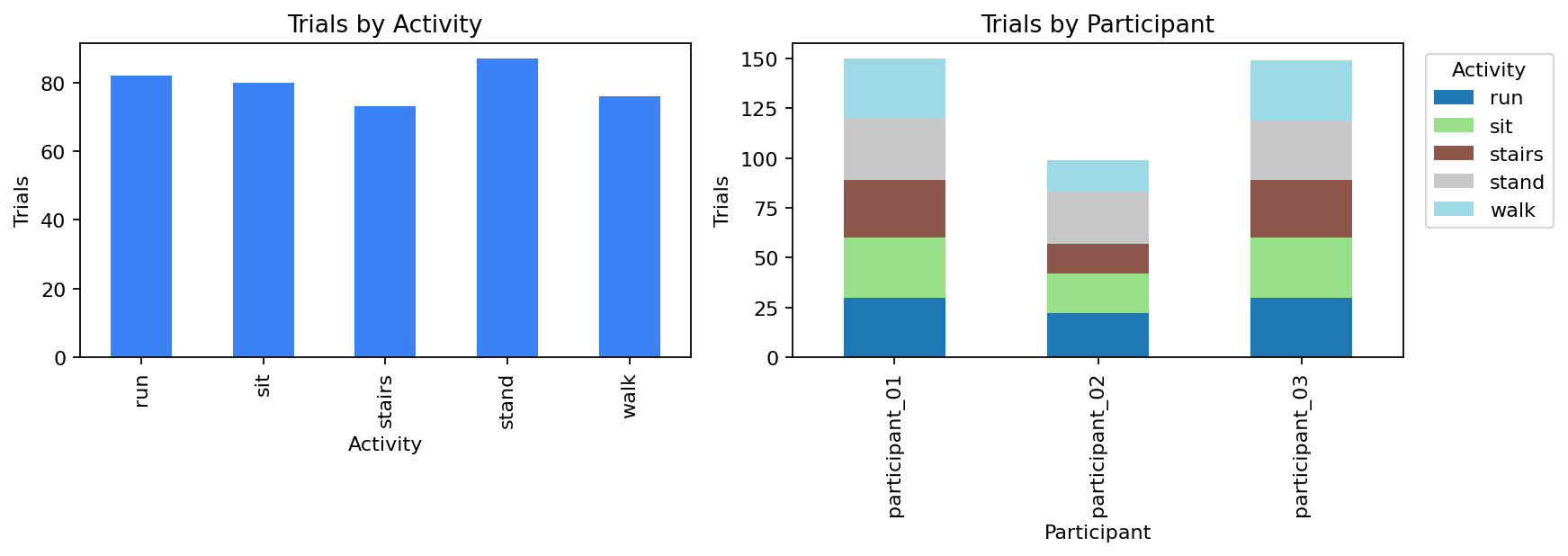
The raw recordings are not published, since they contain participant sensor traces. The repository ships a derived feature table with participant identifiers anonymised and timestamps and local paths removed.