VFRM Agentic Design Assistant
Local LangGraph agent that explores design regions for a VFRM linear electromagnetic actuator, combining surrogate models, NSGA-II optimization, feasibility checks and clustering behind human review steps.
- Role
- TU/e course 5ARIP10, Team 1, in collaboration with ASML
- Stack
- PythonLangGraphNSGA-IISurrogate ModelsRAG
Source code is private
Problem
Choosing the geometry of a VFRM linear electromagnetic actuator means trading several objectives against each other at once: moving force, moving mass, and the AC and DC components of power loss. Evaluating a candidate properly means running a finite element simulation, which is far too slow to search a seven-dimensional space directly.
Approach
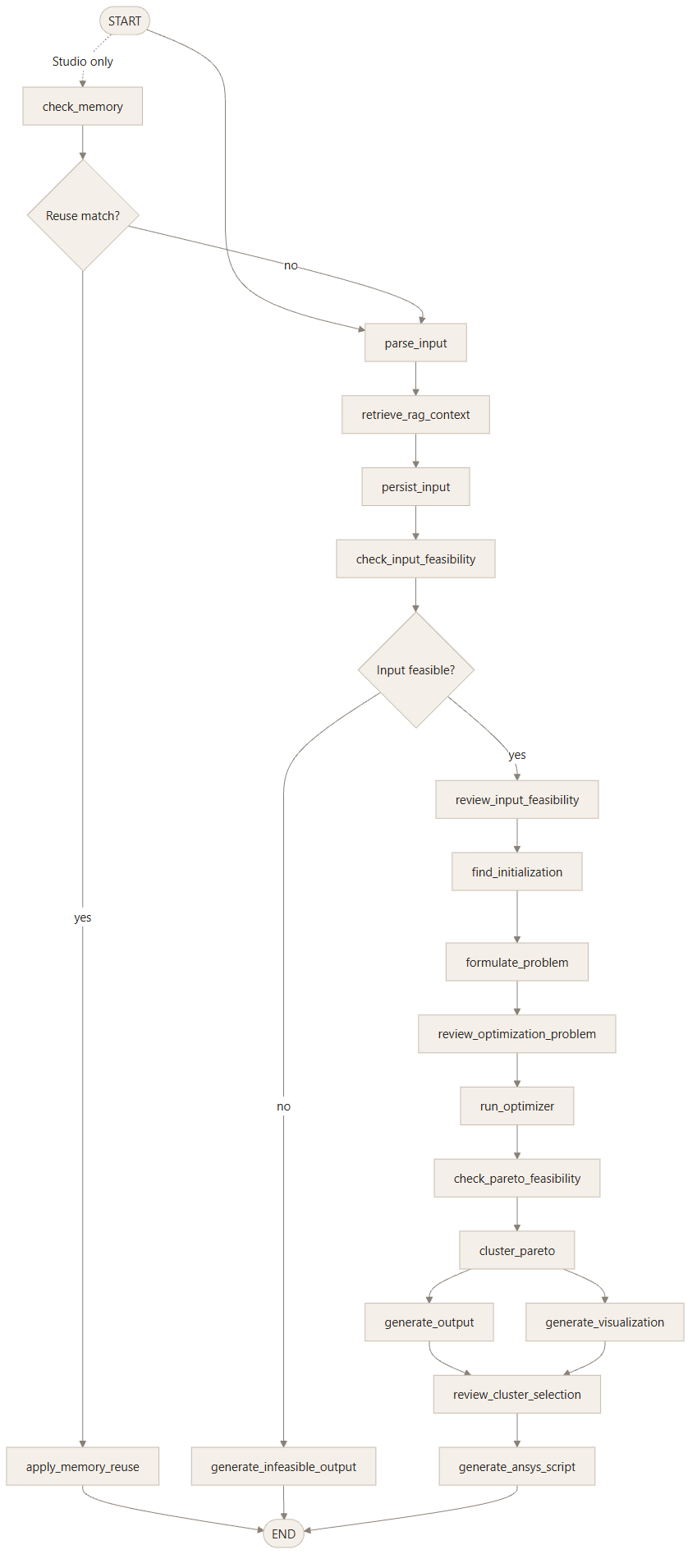
The assistant is a LangGraph agent that runs locally. It parses an engineer’s stated goal, retrieves context from a local literature set, and checks whether the request is feasible at all before any optimization starts. Infeasible requests exit the graph early with an explanation rather than consuming a search.
Feasible requests are turned into a formulated optimization problem, solved with NSGA-II against trained Kriging surrogate models that stand in for the simulation, then checked for Pareto feasibility and clustered into representative design regions. The run ends by exporting an ANSYS sweep script so the candidate regions can be taken back into simulation.
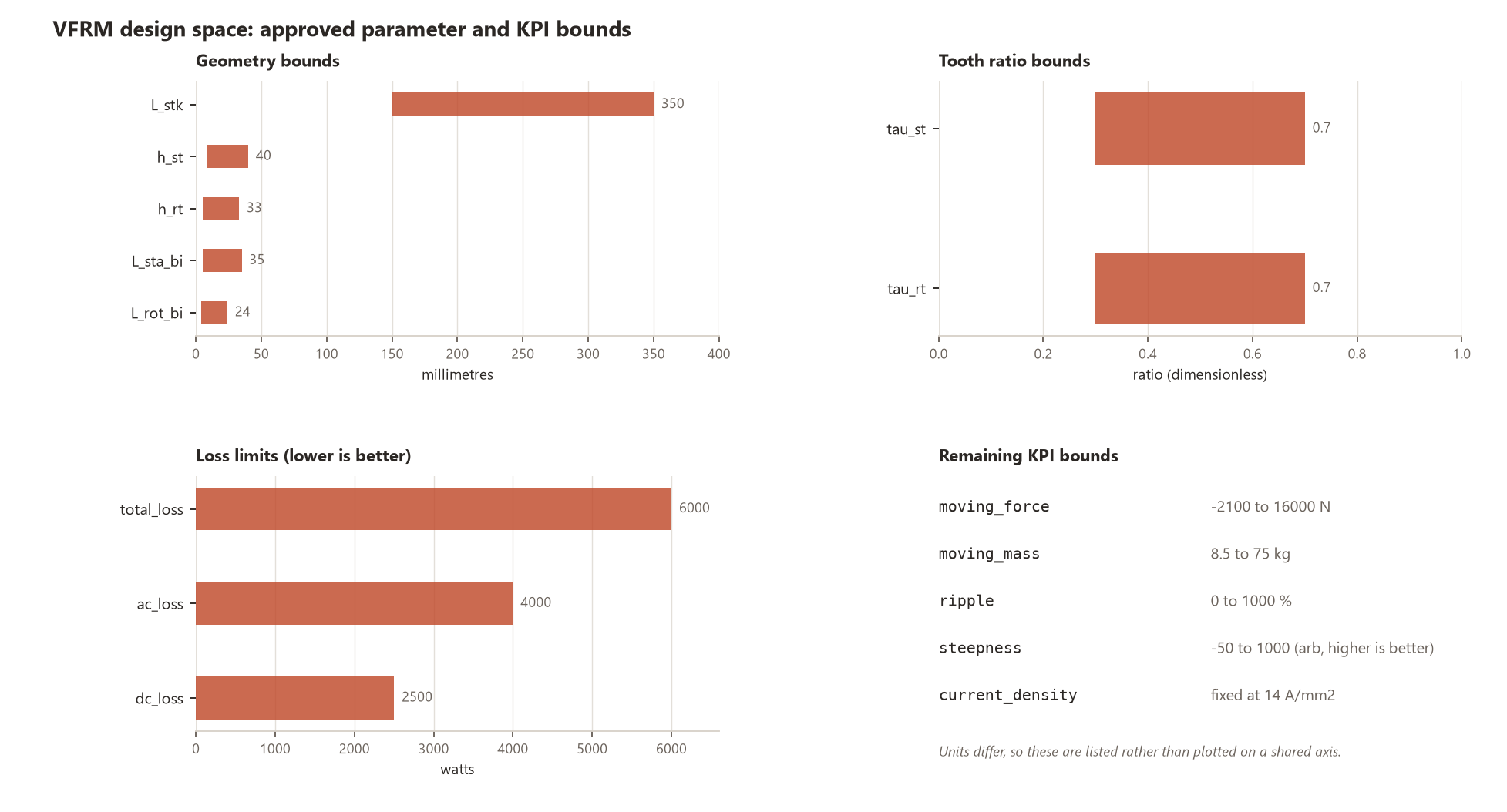
Two design decisions are worth drawing out. Human review steps are wired into the graph between stages rather than bolted on at the end, so an engineer confirms the feasibility reading, the formulated problem, and the cluster selection as the run proceeds. And current density is deliberately held fixed at 14 A/mm² for this study: it is carried through candidate outputs and feasibility checks, but it is not optimized and no separate surrogate is trained for it.
Scope
The agent does not certify a final actuator design. It returns Pareto design regions and representative cluster information for follow-up engineering review, and the search bounds it works within are the approved ones shown above, sourced from ANSYS sweeps.
Attribution
This was team work for TU/e course 5ARIP10, carried out by Team 1 in collaboration with ASML. It is not an ASML product and carries no endorsement from ASML.
The SMT/Kriging surrogate models the agent calls were pre-trained by a teammate and integrated into this work, not trained as part of it. The contribution here is the agent itself: its graph, the problem formulation, the optimization and clustering workflow, and the human review steps around those models.